

This Is What the UK Could Have Been – A Focus on Norway.

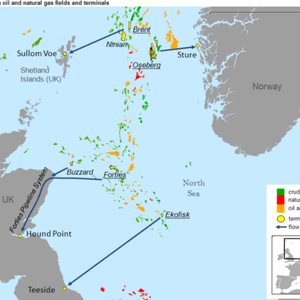
Figure: Existing North Sea oil and gas fields.
Back in the 70s, the UK and Norway struck massive oil and gas reserves in the North Sea at the same time. Norway took that windfall and turned it into a $1.7 trillion sovereign wealth fund. Today, it’s the world’s biggest public wealth fund.
What’s striking is that the UK missed out on a potential £354 to £400 billion national asset due to a lack of oversight.
Read on, because we are going to take a closer look at this billion-dollar blunder. What actions did Norway take that were so different from the UK?
We’ll also discuss Norway’s sovereign wealth fund’s recent exposure to bitcoin. The main idea we’ll be looking at is that the merit of a strategic digital assets reserve is emerging at a crucial moment in the UK’s pursuit of a sovereign wealth fund.
This is because the UK National Wealth Fund, formally established in October 2024, now has a funding of £27.8 billion.

Figure: Chair of the Committee, Dame Meg Hillier, on the UK National Wealth Fund.
Its main investment focus is on green and high-growth industries, but its success depends on its ability to attract private investors. However, the Treasury has made it clear that they’re not setting up a strategic digital asset reserve.
So, is the UK continuing to make poor decisions while Norway is leading the way with its sovereign wealth fund?
The shared fortune, divergent destinies
We’ll set the stage with Norway’s discovery of the Ekofisk oil field in 1969. So, on the discovery of oil, the Norwegian government adopted the principle of a “qualitatively better society”.
Essentially, that philosophy enabled Norway to transform a one-time natural resource into lasting social and economic benefits for everyone. To put it simply, they built a more cohesive and equitable society by providing citizens with greater equality and universal welfare.
Norway was so successful at creating a welfare state that, by 1976, according to a Gallup poll, 76% of Norway’s 4 million population felt that they were “too well off” compared to the rest of the world.
A 1976 article in the New York Times described Norway as a large and growing middle class of “factory workers living nearly as well as their bosses”.

Figure: Norway’s take on prosperity in the 70’s.
How Norway avoided the Dutch Disease
So, how did Norway achieve this rare feat?
Well, at the discovery of oil, Norway limited annual spending of oil revenues to around 25 billion Norwegian kroner. This is roughly $4.2 billion in today’s terms. It did so to prevent inflation and fiscal imbalances, making investments towards building long-term national capacity.
However, a banking crisis in the late 1980s, triggered by overinvestment in physical infrastructure and heavy industry, was a significant reality check.
Creation of Norway’s Sovereign Wealth Fund
So, in the 1983 Tempo Committee report, Norwegian economists advised the government to invest most of the oil money abroad to avoid the ‘Dutch disease’.

Figure: Dutch disease
The Dutch Disease is also sometimes referred to as the resource curse. It’s an economic phenomenon where a sudden boom in one sector, typically, the discovery and export of a natural resource, leads to a decline in other sectors, particularly manufacturing and agriculture.
It is “Dutch” because of events that took place in the Netherlands in the 1950s. First, they discover the massive Groningen gas field. By the 1960s, gas exports were growing, but the Dutch economy was in decline.
Well, their currency, the guilder, had shot up in value because of all the revenue flooding in. This means that a strong currency may sound great, but it comes with a pitfall.
Dutch exports, like manufacturing, agriculture, and even tulips, became more expensive on the global market. Now, since their exports could not compete, factories began to struggle, citizens lost their jobs, and the economy began to crumble.
So, how does this ‘resource curse’ actually work? Well, imagine if the Norwegian government had spent all that oil money at home. It would have set a trap for itself. First, the oil sector would have paid such high wages that it would have sucked all the talent away from traditional industries like fishing or agriculture, which simply couldn’t compete.
Second, all that foreign cash flooding in makes the currency too strong. While that sounds great, it makes all your other exports too expensive for the rest of the world to buy. Your economy therefore becomes dangerously dependent on that one resource. And when the price crashes or the wells run dry, the whole country suffers.
But Norway recognised this trap. That’s why, instead of spending the money at home, they saved it and invested most of it overseas — buying up foreign stocks, bonds, and property. The money eventually returned as investment returns, but the slow pace prevented sudden, huge increases in domestic spending and inflation.
The structure of Norway’s Sovereign Wealth Fund
This brings us to the next big point: the democratic structure of Norway’s Sovereign Wealth Fund.
In keeping with its vision to create a cohesive and equitable society, Norway asserted its sovereignty over its oceanic resources in the 1960s. After that, it enacted laws declaring that resources within its territory belong to the Norwegian state.
That’s why, while oil exploration began in 1969 with foreign companies, by 1972, state-owned Statoil and private Norwegian companies, such as Saga Petroleum, had become central to the exploration process.

Figure: Statoil Mongstad Refinery

Figure: The A platform on Snorre, the first development where Saga Petroleum served as operator.
The outcome was that, in 1983, when the “Tempo Committee” proposed the idea of a dedicated fund, oil revenue began to stream into the fund from Statoil and its investments.

Figure: The Norwegian SWF and the Tempo Committee
As a result, the Government Pension Fund Global was in operation by 1990, with a mandate that governed fiscal policy for informed decision-making regarding market oil volatility and anticipated the future needs of an ageing working population.

Figure: Government Pension Fund Global history
The fund would also create a plan that takes into consideration the decline in production and income, and, in addition, ensures that Norway can create intergenerational equity from its windfall.
So, as you can see, Norway was thinking decades ahead to secure its future. It didn’t sacrifice detail over short-term financial or political pressures.
What does the Government Pension Fund Global invest in?

Figure: Norway’s Sovereign Wealth Fund

Figure: How the Norway SWF is invested
Before 1996, the fund’s focus was on government bonds. However, in 1998, the fund established the Norges Bank Investment Management as fund managers. Since the 2000s, its portfolio has widened to include emerging market equities, corporate and securitised bonds, small-cap companies and unlisted real estate.
Today, the Government Pension Fund Global’s allocations include equity investments at 70.6%, fixed income at 27.1%, unlisted real estate at 1.9%, and unlisted renewable energy infrastructure at 0.4%.
To put this into context, the fund holds shares in approximately 9,000 companies across 70 countries, which equates to nearly 1.5% of all listed companies globally, in addition to owning hundreds of buildings in major cities.

Figure: Norway SWF buys London’s iconic Covent Garden for £570 million
The easiest way to see the effect of the fund’s investment capability is that in March 2025, it bought a 25% stake in London’s iconic Covent Garden for £570 million. Besides that, in January 2025, it had made a £306 million investment for a 25% stake in the Duke of Westminster’s Grosvenor estate.
What that means is Norwegians pocket a share of the UK rental income. At the same time, the UK spends billions as a net importer of Norway’s crude oil and natural gas, adding more revenue to Norway’s trillion-dollar fund.
And that’s how a country with a population of just over five million manages to build a mind-boggling $1.7 trillion fund.
How the UK missed its golden moment
So, while Norway was succeeding at creating a ‘well-funded’ welfare state, the UK had different economic ideologies. It all began with the discovery of gas and oil on the Montrose field in 1969 and the giant Forties Oil Field in 1970.
At the start, the UK oil fields were producing much more than Norway.
However, this new oil wealth arrived at a moment of national crisis. In the early 1970s, just as the UK’s oil began to flow, the global Oil Shock recession hit an already vulnerable British economy. What followed was a decline in the UK’s GDP of 3.9%, and annual inflation reached a post-war peak of over 25% in 1975.
As a result, for the first time since World War II, the world’s largest economy at the time required an IMF bailout in 1976. Part of the IMF bailout conditions included drastic spending cuts and austerity measures.
As a side note, there’s fresh speculation that the UK might need a new IMF bailout.


Figure: Speculation about the UK and a new loan from the IMF
So, when the oil revenues came flooding in, the then Labour Prime Minister James Callaghan
said that oil was “God’s gift to the British economy”.

Figure: James Callaghan, Baron Callaghan, Prime Minister of the United Kingdom
Public asset privatisation
And so, as Norway is squirrelling away its oil revenue to build a cohesive economy, at the top of the UK’s list of priorities was meeting its immediate fiscal needs. We’re talking massive tax cuts, financing, managing public debt, or responding to the economic pressures of the day. Or in other words, the focus was on the present rather than the future.
So, at the end of the day, Norway’s oil resources were under democratic control while the UK’s resources fell into private hands. This problem began with Margaret Thatcher, a stout supporter of free market economics, coming to power in 1979.
Under her economic philosophy, the government sold state entities like British Gas and British Petroleum in the 1980s to private entities. So, the UK government didn’t directly own or control oil and gas revenues.

Figure: Baroness Margaret Thatcher, the ‘Iron Lady’, the first female British Prime Minister
Poor trade decisions
That brings us to the next big point. In Norway, the state could govern fiscal policy for proper decision-making regarding its oil resources. For this reason, the Norwegian government earned $30 per barrel of oil by selling it when prices were high.
Meanwhile, the UK continued to sell oil even when prices were low. This means that when global oil prices slumped, as in 1978, to $14 a barrel, the UK continued to sell.
This is because every barrel sold generated revenue, and with taxes like the Petroleum Revenue Tax increasing to 75% by the late 1970s, even low prices meant billions for the Treasury.
Tax chaos
Third, the government placed erratic tax measures on oil revenues.

Figure: Headline UK oil and gas tax rates since the 1970s
When the UK struck oil, the government implemented an aggressive tax regime. By 1975, they introduced the Petroleum Revenue Tax at 45%, which, combined with corporation tax and royalties, raised the effective tax rate to around 83%.
By 1979, the Petroleum Revenue Tax rate at 75%, while the total government’s take was sometimes over 90%. It was significant revenue. £12 billion in 1984-85 was about 3% of GDP.
However, here’s the catch: instead of saving it like Norway did, the UK invested most of that money in immediate needs.
Besides that, the UK tax rates were also inconsistent. This rollercoaster has made revenues volatile, ranging from £12.4 billion in 2008-09 to £0.5 billion by 2020-21, then increasing to £9.9 billion in 2022-23.
The tax changes didn’t just affect the government’s budget; they shaped the oil industry itself. High taxation made some fields barely profitable, slowing exploration in tougher areas.
And by the ‘80s, the government realised this and cut down on taxation, scrapping royalties for new fields, and added reliefs. This sparked a boom, with UK production peaking in 1999 at 1.7 million barrels a day, outpacing Norway for a time.
But, while lower taxes boosted output, there was a cost. The UK got less per barrel, at $11, compared to Norway’s $30. Essentially, the tax system allowed companies to retain a greater share of their profits. By the 2000s, when the UK tightened its taxes again, production had already begun to decline.

Figure: In the 70s and 80s, the UK produced more oil than Norway
So, inconsistent policies forced companies away from ageing fields. As a result, the UK reserves are at 3.3 billion barrels of oil, while Norway has 5.4 billion barrels of oil.

Figure: British oil and gas production decline
So, did the UK catch the Dutch disease?
Yes, it did. This is because in the early 1980s, oil production rose sharply, and at the time, the pound’s value was relatively high. But when oil prices later dropped, it triggered a recession and a steep fall in the pound.

Figure: Sterling exchange rate index
For instance, in the early 1970s, one Pound was worth $2.5. However, by the 1980s, this value had fallen to a low of $1.05, essentially crippling British exporters and leading to a devastating decline in British manufacturing.
By the 1980s, Britain’s welfare state dream was fading, revealing a significant inequality between the poor and the rich. The cause of this gap could have been caused by higher earners from the oil boom investing their revenue in real estate, leading to a rise in home costs.
To make matters worse, Instead of investing the oil revenue, the government began privatising public housing, selling off social housing, while also reducing public sector investment from an average of 4 percent in the 1970s to about 1 percent in the 1990s.
As a result, the UK currently faces a severe housing shortage, with an estimated shortfall of around 6.5 million homes. It’s the second-worst rate among comparable European nations. While the UK has a homeownership rate of 63% and is still in decline, Norway’s homeownership rate stands at 81.5%, partly due to its pro-homeownership policies.
What the UK could have had: The scale of a missed opportunity
Building on that, economists have calculated just how much money the UK has missed after the privatisation of state oil corporations. For instance, the sale of Britoil in 1982 generated over $1 billion for the cash-strapped government.

Figure: Privatisation of Britoil. November 23, 1982, The Times’s print archive
However, data shows that had it remained a public entity, it would have generated over $400 billion in revenues for the public. Think of it like this: if the UK had a £400 billion Sovereign Wealth Fund, each citizen would hypothetically own an average of £5,867.
Here’s a different perspective. A £400 billion fund would cover approximately 13.75% of the UK’s current national debt, making a significant dent in the country’s outstanding obligations.
Here’s why that matters.
Norway’s sovereign wealth fund means that every citizen’s got a $300,000 share of national wealth. Therefore, there’s accessible quality education and healthcare, which have contributed to Norway’s place as the 7th happiest nation on earth.

Figure: Norway’s ranking on the World Happiness Report
The UK, on the other hand, needs high taxes and debt to fund public services. So, its citizens’ happiness rank is at the 23rd spot with a lower GDP per capita of $49,000 versus Norway’s $88,000.

Figure: UK’s ranking on the World Happiness Report
A contemporary solution: The UK Strategic Bitcoin Reserve question
Lastly, let’s explore the current relevance of the historical divergence in managing North Sea oil wealth between Norway and the UK, as well as the ongoing debate surrounding strategic national reserves of digital assets, specifically bitcoin.

Figure: Lord Elliot of Mickle Fell’s question to the UK Treasury

Figure: UK Treasury has no plans to adopt a strategic Bitcoin reserve
According to recent statements from the UK Treasury, the UK government’s investment philosophy remains significantly different from Norway’s. Norway adheres to its standard investment rules, yet still benefits from Bitcoin’s success.
This is because, while state pension funds can only invest in a set of asset classes such as equities, bonds, or fixed-income securities, Norway’s asset fund has exposure to bitcoin. But they don’t hold crypto directly. Instead, they hold assets whose value rises in tandem with that of BTC.
For instance, since 2024, the fund has increased its crypto company holdings by a whopping 192% according to K33 Research.

Figure: Norway’s sovereign wealth fund crypto exposure
That’s exposure to approximately 7,161 BTC through smart proxies, such as treasury companies Strategy and Metaplanet.
Additionally, it has increased its Coinbase stock holdings by 96% during the same period. Additionally, they are holding over 11.9 billion Norwegian kroner, equivalent to $1.2 billion in Strategy stock, a 133 per cent increase from last year.
But unlike Norway’s government, which does not hold Bitcoin directly, the UK government holds approximately 61,000 BTC. That makes the UK one of the top governmental holders worldwide, third-largest after the US and China.
The UK BTC stash has a rough value of $7.2 billion USD and comes entirely from criminal seizures, rather than purchases or strategic reserves.
A quick tip. Take control of your crypto security by keeping your assets on a secure hardware wallet or cold storage device, like Trezor’s latest top-of-the-range model, the Trezor Safe 5.


And after that, the next crucial step is securing your seed phrase. Cryptotag’s Zeus model is the leading and best-selling storage device for that.

Now, since the UK Treasury has no plans for a national Bitcoin reserve, unlike the US’s Strategic Bitcoin Reserve plans, it might instead opt to sell portions to address fiscal shortfalls.

Figure: The US strategic bitcoin reserve
What does that remind us of?
Selling off a valuable, long-term asset to plug a hole in the budget? Because the question here is whether this is the same short-sighted logic that cost the country its North Sea oil fortune?
Because it looks like its policies are not driven by long-term wealth growth or ensuring fairness for the next generation. So, the UK is so cautious about bitcoin’s volatility that it has prioritised regulation and stability over the opportunity to invest in long-term national benefits.
Well, at the end of the day, policymakers needed to look past next week and fully consider the multi-generational impact and the power of compounded returns.
If you’d like to learn more about long-term crypto holding strategies, I offer one-on-one coaching. If you are interested in learning and self-development, please contact me to book a complimentary call and determine if we’re a good fit.
Conclusion
To summarise, both the UK and Norway hit the jackpot with massive North Sea oil and gas discoveries in the 1970s. While Norway played the long game, channelling its windfall into a sovereign wealth fund, the UK spent their revenue on short-term fixes. Economists say the UK missed out on a £354-400 billion fund.
Fast-forward to today, Norway’s fund has indirect exposure to bitcoin, while the UK holds 61,000 seized BTC but lacks strategic reserve plans, potentially selling it off instead of letting it grow. With BTC forecasts eyeing $300k-$1.5 million by 2030 as “digital gold,” we’re left wondering if the UK’s caution is repeating history and missing another shot at intergenerational wealth.
And so, there you have it, the tale of two nations and the billion-dollar what-ifs from North Sea oil to Bitcoin reserves. Should the UK reconsider its strategy and establish a strategic Bitcoin reserve?

If you’re looking for an easy way to track and stay on top of your crypto investments, you can check out CoinStats, which is the leading cryptocurrency portfolio tracker.

There’s also Koinly, one of the best automated crypto tax platforms available. Sign up for a free account.
If you’re looking for more personalised crypto tax help, you can contact Crypto Tax Audit, which is a leading US crypto tax firm.
And if you’re reading from the UK, you can contact Myna, a specialist and highly qualified UK crypto tax company. If you do need any help with crypto tax planning, they’re both worth checking out.


Ready to Start Your Crypto Journey with Confidence?
Our upcoming Crypto Foundations course is designed to give you the essential skills to navigate the world of digital assets safely and effectively.
Don’t miss out!
Click here to join the waitlist to get exclusive updates and be the first to know when we launch.