

How Crypto AI Agentic Wallets Are Allowing Automatic Payments Without Humans
The rapid rise of agentic AI is introducing a new model of digital interaction, where autonomous systems can operate independently and transact across the internet. These digital agents are increasingly able to bypass traditional banking infrastructure, using crypto networks to execute transactions without human intervention.
This article examines how these systems function, including the role of blockchain-based payments, emerging protocols such as the x402 payment standard, and developments in digital identity on networks such as Ethereum. It also considers the advantages and limitations of this evolving model, as well as the growing institutional interest in this space.
Nothing contained in this article constitutes financial advice.
WHAT ARE AI AGENTS?
AI agents differ significantly from traditional chatbots. While standard chatbots are designed to respond to prompts or answer questions, AI agents operate as independent digital workers.
An AI agent is assigned a specific objective and determines the steps required to achieve it autonomously. These systems can interpret instructions, make decisions, and complete multi-step tasks without direct human involvement.
For example, an AI agent could be instructed to find the cheapest flights to London for a specific date. Rather than simply presenting a list of search results, the agent could navigate booking platforms, select appropriate options, complete the purchase, and add the itinerary to a calendar.
In financial contexts, AI agents can be programmed to monitor decentralised markets and execute complex trading strategies. They can operate continuously, reallocating capital and responding to market conditions in real time.
Major corporations are actively developing these capabilities. Alibaba, for example, has launched platforms such as Wukong, an AI-native enterprise system, and Accio, designed for international business workflows. These systems coordinate multiple AI agents across organisational processes, enabling tasks such as inventory management, spreadsheet updates, and invoice processing to be handled autonomously.


Figure: Alibaba Launches Wukong and Accio to Power AI-Driven Enterprise and Global Workflows
The adoption of AI agents is being driven by efficiency gains. Digital workers can reduce operational costs by up to 30 percent, while data suggests that 96 percent of enterprises are expanding their use of AI agents. Additionally, 83 percent of executives report that such investment is essential to remain competitive in an increasingly automated economy.

Figure: AI agents drive efficiency: cut costs up to 30% as 96% of enterprises expand adoption and 83% of executives call it essential for competitiveness.
The scale of this emerging sector is also significant for both investors and companies. Research from Edgar, Dunn & Company predicts that AI agentic commerce volume, referring to the value of transactions executed by these agents on behalf of users, could reach $1.7 trillion by 2030.

Figure: AI agentic commerce could reach $1.7 trillion by 2030, as autonomous agents reshape digital transactions.
Despite this growth, AI agents face a fundamental limitation. They cannot open traditional bank accounts because they do not possess a recognised human identity and cannot pass standard KYC requirements, such as providing passports or other forms of identification. As a result, they are effectively excluded from the conventional financial system.
This limitation is one of the key reasons why the machine economy is increasingly built on crypto infrastructure.

Figure: Coinbase introduces agentic wallets, enabling AI agents with self-custodial crypto addresses to hold funds and transact autonomously across blockchains.
To address this, companies such as Coinbase have introduced agentic wallets. These provide AI agents with standalone, self-custodial crypto addresses, allowing them to hold funds independently and execute transactions across blockchain networks.
In practice, many AI agents rely on stablecoins for transactions. Stablecoins offer predictable and fast settlement while remaining pegged to fiat currencies, making them more suitable for accounting and operational purposes. This reduces the volatility associated with traditional digital assets such as Bitcoin.

Figure: Over 13,000 AI agents registered on Ethereum in a single day, signaling rapid growth in autonomous on-chain activity.
Adoption of this technology is accelerating. More than 13,000 AI agents registered on the Ethereum network in a single day, highlighting the speed at which this ecosystem is developing. Coinbase CEO Brian Armstrong has suggested that AI agents could soon outnumber humans in terms of transaction activity.

Figure: Coinbase CEO Brian Armstrong suggests AI agents may soon surpass humans in transaction activity.
CZ has predicted that these agents may eventually execute transactions at a scale far exceeding human participation, primarily using crypto networks.

Figure: CZ predicts AI agents could one day execute crypto transactions at a scale far beyond human activity.
ADVANTAGES AND DISADVANTAGES
Before examining the underlying infrastructure, it is important to assess the benefits and risks associated with granting AI agents autonomous financial control.
One of the primary advantages is speed and efficiency. AI agents can automate time-consuming manual tasks, process large volumes of data, and streamline complex workflows. This applies across both everyday and financial use cases.
For example, AI agents can automate routine activities such as booking services or managing subscriptions, while also processing large volumes of invoices instantly. In financial markets, they can execute more advanced functions such as yield farming, portfolio rebalancing, identifying patterns in large datasets, and executing trades faster than human participants.
These efficiencies reduce reliance on manual labour and traditional intermediaries, leading to lower operational costs. In addition, AI agents remove emotional decision-making from investing. Instead of reacting impulsively to market conditions, they operate purely based on predefined logic and can function continuously without interruption.
However, these systems also introduce significant risks.
Large language models, which underpin many AI agents, can occasionally generate inaccurate or mislecoaching outputs. This could result in incorrect transactions, such as executing a flawed trade or completing an unintended action.
AI agents are also highly dependent on data quality. If they rely on manipulated or inaccurate inputs, this can lead to costly errors. Furthermore, these systems present new attack surfaces for malicious actors. Exploits could involve manipulating instructions, accessing sensitive data, or diverting funds, ultimately compromising both security and outcomes.
There are also broader ethical concerns. Questions arise around accountability, misuse by bad actors, and the mechanisms required to monitor and control these systems.
Finally, the automation enabled by AI agents may contribute to workforce disruption. As more tasks become automated, the challenge will be maintaining human relevance, preserving skills, and adapting to a potentially reduced demand for traditional roles.
Security of AI Agents
For the agentic AI economy to function securely, a robust cryptographic trust layer is essential. Autonomous systems cannot be allowed to manage financial resources without strong safeguards.
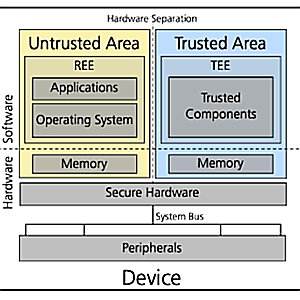
Agentic wallets address this through the use of Trusted Execution Environments, or TEEs. A TEE is a secure area within a device’s processor that isolates sensitive data from the rest of the system.


Figure: Trusted Execution Environment; a secure processor area that isolates sensitive data from the rest of the system.
These environments are already widely used in applications such as mobile payments and biometric authentication. For example, technologies like Apple Pay and fingerprint unlocking rely on TEEs to securely store and process sensitive information. Similarly, some hardware wallets use TEEs to keep private keys isolated from external threats.
In the context of blockchain applications, TEEs allow decentralised systems to operate effectively while maintaining the confidentiality of underlying data.
In addition to TEEs, smart contracts are used to enforce financial controls. These contracts can include programmable spending limits and session restrictions, acting as safeguards against unintended behaviour.
For instance, even if an AI agent produces an incorrect output, it cannot exceed predefined spending thresholds. Any transaction that breaches these limits is automatically rejected by the smart contract, providing an additional layer of protection.

Self-custody and the security of people’s crypto is key to us at Coin Knowledge as a business focused on education, so, holding your assets securely in a hardware wallet, in cold storage, in something like a Trezor is key.
Figure: Trezor, a leading company providing secure hardware wallets for cryptocurrency storage and management.

The latest top-of-the-range model of Trezor is, the Trezor Safe 5.
Figure: Trezor Safe 5, a next-generation hardware wallet designed for secure cryptocurrency storage and management. Source: Trezor.
The next crucial step is securing your seed phrase. Cryptotag is the leading and best-selling storage device for that.

Figure: Cryptotag, a company known for its premium titanium backup solutions for securely storing cryptocurrency recovery phrases. Source: Cryptotag.
Can You Trust Agentic AI?
Establishing trust between humans and AI agents, as well as between agents themselves, is a critical challenge in decentralised systems.
One proposed solution is the Ethereum-based ERC-8004 standard, often referred to as the Trustless Agents protocol. This framework provides identity and verification infrastructure for the agent economy.

Figure: ERC-8004 on Ethereum, known as the Trustless Agents protocol, enables secure and autonomous AI agent interactions on-chain.
It operates through three key mechanisms.
- First, each AI agent creates a verifiable on-chain identity, allowing it to be recognised across networks.
- Second, users can leave public feedback, contributing to a transparent reputation system that reflects the agent’s reliability.
- Third, the protocol enables cryptographic proof that specific tasks have been completed as agreed.
This structure allows agents to assess the credibility and performance history of other agents before engaging in transactions, creating a more secure and trustworthy ecosystem.
Google’s AP2 & Coinbase’s X402 Protocols
A key question is how AI agents interact with websites and purchase digital resources. This is where major technology firms are playing a central role.
Google has introduced the Agent Payments Protocol, or AP2, an open framework developed in collaboration with over 60 companies.

Figure: Google Cloud Announces Agent Payments Protocol to Enable Secure AI-Driven Transactions.
Participants include Mastercard, PayPal, American Express, Etsy, Coinbase, MetaMask, Mysten Labs, Revolut, and Worldpay.

Figure: Global Partners Collaborate on Agent Payments Protocol to Enable AI-Driven Transactions.
AP2 is designed to provide a universal and secure system for AI-driven payments across the internet. Instead of requiring manual input, such as entering card details at a paywall, websites can issue payment requests directly to AI agents in the background.
The agent receives this request, signs a secure digital agreement known as a mandate, and executes the payment to unlock the requested resource.
Importantly, AP2 is not limited to traditional payment methods. Google has integrated a crypto extension into the protocol known as x402, originally developed by Coinbase. This allows AI agents to settle transactions natively using stablecoins.

Figure: Powering AI Commerce with AP2: Coinbase Highlights How x402 and Agent Payments Protocol Enable Seamless Agent-to-Agent Transactions.

Figure: Linux Foundation Launches x402 Foundation to Advance Open Standards for AI and Agent-Based Payments.
The x402 standard is now governed by the Linux Foundation with Jim Zemlin, the CEO of the Linux Foundation, stating that the internet was built on open protocols.


Figure: Jim Zemlin, CEO of the Linux Foundation.
As a non-profit organisation, the Foundation ensures that the protocol remains open, neutral, and interoperable, rather than being controlled by a single entity. Its leadership has emphasised that the internet itself was built on open standards, and this approach is intended to maintain that principle.
The ecosystem supporting x402 includes major infrastructure providers such as Amazon Web Services, Google, Microsoft, Cloudflare, Stripe, and Circle, alongside established financial networks including Mastercard and American Express.
Stripe and OpenAI’s ACP
Alongside fully autonomous systems, hybrid frameworks are also emerging. One example is the Agentic Commerce Protocol, or ACP, developed by Stripe in collaboration with OpenAI.

Figure: Agentic Commerce Protocol: Enabling Autonomous AI-Driven Transactions and Digital Trade.
This protocol acts as a bridge between AI agents and traditional e-commerce platforms such as Shopify and Etsy. It enables AI systems to initiate purchases using existing payment methods, including credit cards.
However, these transactions still require human authorisation at the final stage. A user must confirm the purchase, for example by approving the transaction within a shopping cart interface.
This approach ensures that merchants maintain their direct relationship with customers and continue operating within established payment networks. While effective for purchasing physical goods, it does not represent full autonomy.
Fully autonomous transactions present additional challenges. For example, an AI agent may need to purchase small units of digital data or services from another agent in real time.
Traditional payment networks are not designed for this use case, as they involve fixed fees that make micro-transactions economically unviable.

Figure: AI agents generated approximately $31 billion in payment volume on the Solana network, highlighting rapid growth in autonomous on-chain transactions.
Blockchain-based systems face similar challenges when network fees are high. However, the demand for such transactions is already evident. In 2025 alone, AI agents generated approximately $31 billion in payment volume on the Solana network.
To address this, the x402 protocol is designed to be blockchain agnostic. It supports efficient, low-cost networks such as Base, Solana, and Polygon, where transaction fees are minimal. This enables the high-frequency, low-value transactions required for machine-to-machine economies.
CONCLUSION
The convergence of AI and crypto is accelerating rapidly, reshaping how digital systems interact and transact.
AI agents are evolving into independent economic actors. Because they cannot access traditional banking systems, they rely on crypto infrastructure, particularly stablecoins, to operate.
At the same time, the development of open standards such as x402 provides a neutral framework supported by major global technology companies. This ensures interoperability and reduces the risk of centralised control.
Finally, blockchain networks are addressing the cost limitations of traditional payment systems, enabling the low-fee environment required for large-scale autonomous transactions.
Together, these developments point towards a new economic model in which machine-to-machine interactions become a fundamental part of the digital economy.

Ready to Start Your Crypto Journey with Confidence?
Our upcoming Crypto Foundations course is designed to give you the essential skills to navigate the world of digital assets safely and effectively.
Don’t miss out!
Click Here to join the waitlist to get exclusive updates and be the first to know when we launch.